
Static vs Dynamic Website: Which Is Better for Your Business?
Understand the difference between static and dynamic websites, their costs, benefits, limitations and which option is better for your business.
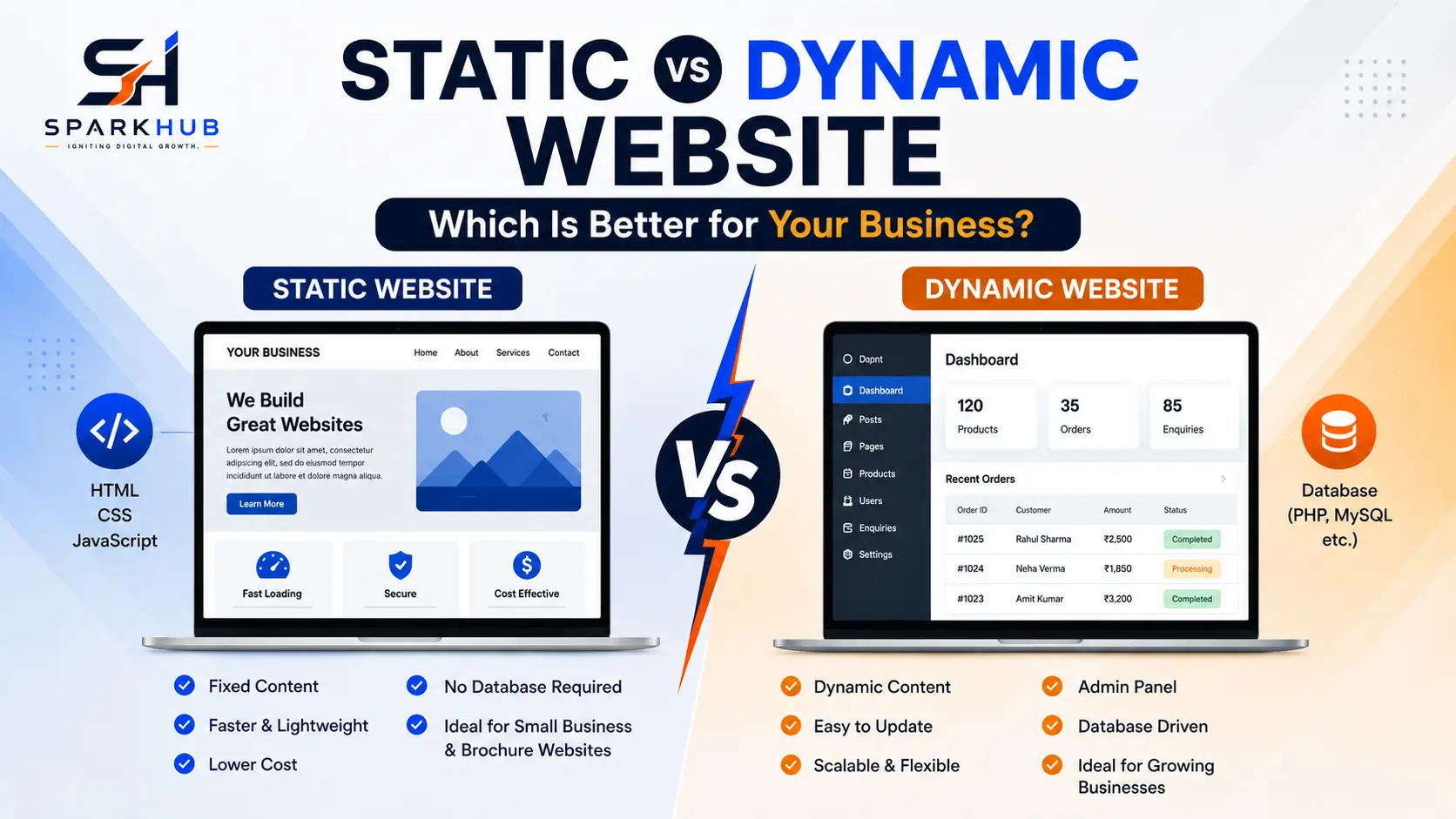
When planning a new website, one of the first technical decisions is whether your business needs a static website or a dynamic website.
Both types of websites can look professional, work on mobile devices and represent a business online. The real difference is mainly in how the website stores information, how content is updated and what functionality it provides.
For a small business with only a few pages, a static website may be completely sufficient. For a business that needs frequent updates, an admin panel, customer accounts, products, blogs or other database-driven functionality, a dynamic website may be the better option.
Simple language mein: agar website mein information mostly fixed rahegi, static website useful ho sakti hai. Agar information regularly change hogi ya website ko data manage karna hai, dynamic website usually better rahegi.
What Is a Static Website?
A static website is a website where the content of each page is generally stored directly in website files.
When a visitor opens a page, the server usually sends the prepared page content to the browser without generating it from a database for every request.
Common technologies used in static websites include:
HTML
CSS
JavaScript
Images and other local media
Static does not mean the website must look old or boring. A static website can still have:
Modern responsive design
Animations
Contact buttons
WhatsApp integration
Interactive menus
Image galleries
SEO-friendly pages
The word static mainly refers to how the page content is managed, not how attractive the website looks.
What Is a Dynamic Website?
A dynamic website can generate or manage content using backend programming and usually a database.
Instead of storing every piece of information directly inside individual page files, the website can retrieve information from a database and display it according to the current request.
Dynamic websites may use technologies such as:
PHP
CodeIgniter
MySQL
JavaScript
Server-side business logic
A dynamic website may provide features such as:
Admin panel
Blog management
Product management
User accounts
Customer dashboards
Search and filtering
Database records
Online payments
Order management
Notifications
In short, dynamic websites are usually more suitable when the website needs to do more than simply display information.
Static vs Dynamic Website: Quick Comparison
Feature | Static Website | Dynamic Website |
|---|---|---|
Content Storage | Mostly stored directly in page files | Often stored in a database |
Admin Panel | Usually not required | Commonly available |
Content Updates | Usually require file changes | Can often be managed from dashboard |
Database | Normally not required | Usually required |
Development Complexity | Lower | Higher |
Initial Cost | Usually lower | Usually higher |
Maintenance | Generally simpler | Requires more ongoing management |
User Accounts | Not normally used | Possible |
Ecommerce | Not suitable for full ecommerce | Suitable |
Best For | Simple informational websites | Interactive and data-driven websites |
Advantages of a Static Website
1. Faster and Simpler to Build
If the requirement is straightforward, static websites can often be developed faster because there is less backend and database functionality to create.
2. Lower Development Cost
Because the architecture is simpler, a static business website can often have a lower initial development cost.
This can be useful for small businesses, startups and professionals that only need an online presence with essential information.
3. Good Performance
Static pages can load very efficiently because the server may only need to deliver prepared HTML, CSS, JavaScript and media files.
However, actual performance still depends on image size, code quality, hosting and other implementation choices.
4. Smaller Security Surface
A website without user accounts, databases or complex server-side functionality generally has fewer application-level components that can introduce vulnerabilities.
That does not mean a static website is automatically secure. Hosting, server configuration and frontend security still matter.
5. Easy for Small Informational Websites
A static website can work very well for:
Small business websites
Portfolio websites
Consultant websites
Landing pages
Simple company profiles
Basic service websites
Limitations of a Static Website
Content Updates Can Require Technical Changes
If business staff need to update pages frequently, manually changing files can become inconvenient.
Not Ideal for Large Amounts of Changing Content
Managing hundreds of products, articles or records directly in page files would be inefficient.
Limited Business Automation
Features such as customer accounts, dashboards, advanced forms, online transactions and database-driven workflows normally require backend development.
Advantages of a Dynamic Website
1. Easier Content Management
Dynamic websites can provide an admin panel where authorized users manage information without editing website source files.
For example, staff may be able to:
Add blog posts
Update services
Manage products
Review enquiries
Update business information
2. Suitable for Large Websites
When a website contains many pages or frequently changing records, database-driven management becomes much more practical.
3. Supports User Accounts
Dynamic websites can support authentication and personalized user experiences.
Examples include:
Customer login
Student login
Staff login
Member dashboard
Order history
4. Business Automation
A dynamic website can become part of a company's operational workflow.
It may handle:
Enquiries
Applications
Admissions
Bookings
Quotations
Orders
Payments
Notifications
Reports
5. Better for Future Expansion
A well-structured dynamic website can support additional modules and integrations as business requirements grow.
Limitations of a Dynamic Website
Higher Initial Development Cost
Dynamic websites require more development because backend logic, databases, validation and security may need to be implemented.
More Maintenance
Backend applications may require:
Security updates
Framework updates
Database maintenance
Backups
Compatibility checks
More Security Responsibility
Authentication, databases, uploads and user-generated information create additional security requirements.
Which Is Faster: Static or Dynamic Website?
Static websites can often be faster because pages can be served with less server-side processing.
However, this does not mean dynamic websites have to be slow.
A properly developed dynamic website can also perform very well through:
Optimized database queries
Caching
Efficient code
Optimized images
Minimal JavaScript
Good hosting
Website speed depends more on implementation quality than simply labeling the project static or dynamic.
Which Is Better for SEO?
Both static and dynamic websites can be SEO friendly.
Search engines care about factors such as:
Useful content
Crawlable pages
Proper headings
SEO titles and descriptions
Canonical URLs
Mobile usability
Website speed
Internal linking
Structured data where appropriate
A static website does not automatically rank better, and a dynamic website does not automatically perform worse.
The technical implementation and content quality matter more.
For ongoing optimization, you can also explore our SEO services.
Which Is More Secure?
A simple static website generally has fewer application-level attack points because it may not use a database, login system or backend administration.
Dynamic websites require more security controls because they process data and user requests.
A professionally developed dynamic application should consider:
Input validation
Authentication
Authorization
CSRF protection
Secure sessions
Password hashing
Safe database queries
Secure file uploads
Backups
Static vs Dynamic Website Cost
A static website will usually cost less when the project requires only a small number of informational pages.
A dynamic website usually costs more because it can require:
Backend development
Database design
Admin dashboard
User permissions
Security controls
Testing
The final cost should always depend on the actual project scope.
For a detailed pricing explanation, read our guide: How Much Does a Business Website Cost in India?
When Should You Choose a Static Website?
A static website may be suitable when:
Your business information changes rarely
You need only a few pages
You have a limited initial budget
You do not require an admin dashboard
You do not need customer accounts
You do not need complex database functionality
For example, a consultant who only needs Home, About, Services and Contact pages may not need a complete dynamic system.
When Should You Choose a Dynamic Website?
A dynamic website may be better when:
You want to update content regularly
You need a blog
You have many products or services
You need an admin panel
You require customer accounts
You need online payments
You want to store and manage enquiries
You require reports or dashboards
You expect future business automation
Example: Small Local Business
Suppose a local electrician needs a website containing:
Home
About
Services
Service areas
Contact information
WhatsApp button
If the information rarely changes, a static website may be enough.
Example: Computer Institute
Now imagine a computer institute that wants:
Course management
Student enquiries
Blog posts
Announcements
Admin dashboard
Online registration
A dynamic website would generally make much more sense because the business needs to manage changing information.
Example: Ecommerce Business
An ecommerce website requires regularly changing data such as:
Products
Prices
Customers
Orders
Payments
Stock information
A complete ecommerce system is therefore fundamentally dynamic.
Can a Website Be Both Static and Dynamic?
Yes.
Many modern websites use a combination of both approaches.
For example:
The About page may contain mostly fixed content
The Blog section may load articles from a database
The Contact page may submit data to the backend
The admin panel may be completely dynamic
Therefore, choosing between static and dynamic does not always mean the entire website must follow only one approach.
Does Every Business Need a Dynamic Website?
No.
This is an important point because more functionality does not automatically mean a better website.
If your business requires only a professional online presence, adding a large database and complicated admin system may unnecessarily increase:
Development cost
Maintenance
Security responsibility
Technical complexity
Jo feature business ko actually chahiye hi nahi, uske liye extra paisa aur maintenance kyun?
The best solution is usually the simplest architecture that can reliably support your current and reasonably expected future requirements.
Does Every Business Need a Static Website First?
Not necessarily.
If you already know that the website needs products, user accounts, online payments or frequently updated content, starting with an intentionally limited static architecture may create unnecessary redevelopment later.
Requirement planning should come before technology selection.
How SparkHub Decides Between Static and Dynamic Development
At SparkHub, the recommendation should depend on what your business actually needs rather than automatically selling the more complicated option.
We consider questions such as:
How frequently will the content change?
Who needs to update the website?
Do you need an admin dashboard?
Do customers need accounts?
Will the website store business data?
Are online payments required?
Do you expect significant future functionality?
If a straightforward website solves the requirement, we can keep it simple.
If the business genuinely needs database-driven functionality, we plan a dynamic solution accordingly.
Technology ka decision feature list dekh kar hona chahiye, trend dekh kar nahi.
Frequently Asked Questions
What is the main difference between static and dynamic websites?
A static website generally serves prepared page content, while a dynamic website can generate or manage content through backend programming and databases.
Is a static website cheaper than a dynamic website?
For comparable design requirements, a static website is generally less expensive because it requires less backend and database development. Final pricing still depends on the project scope.
Can a static website have animations?
Yes. Static websites can include responsive design, JavaScript interactions, animations, image galleries and other frontend functionality.
Can a static website rank on Google?
Yes. Static websites can be fully SEO friendly when they use crawlable content, proper metadata, semantic HTML, useful information and good technical implementation.
Does a dynamic website need a database?
Most dynamic business websites use a database, although dynamic server-side functionality does not technically require a database in every possible architecture.
Which website is better for a small business?
It depends on the requirement. A simple local business may only need a static website, while a business that frequently manages content, products, enquiries or customer data may benefit from a dynamic website.
Can I convert a static website into a dynamic website later?
Yes, but the amount of redevelopment depends on the existing architecture and the new functionality required. Planning likely future requirements early can reduce unnecessary rework.
Final Thoughts
There is no universal winner in the static vs dynamic website comparison.
A static website can be an excellent option for a small business that needs a fast, professional and straightforward online presence.
A dynamic website becomes more valuable when the business needs frequently changing content, databases, customer accounts, ecommerce, administration or business automation.
The right question is therefore not: “Static better hai ya dynamic?”
The better question is: “Mere business ko actually kis functionality ki zarurat hai?”
Once that requirement is clear, the correct website architecture becomes much easier to choose.
If you are unsure which type of website your business needs, explore our website development services or contact SparkHub to discuss your requirements.