
How Much Does a Business Website Cost in India?
Understand business website costs in India, what affects pricing, typical website types, hidden expenses and how to plan the right budget.
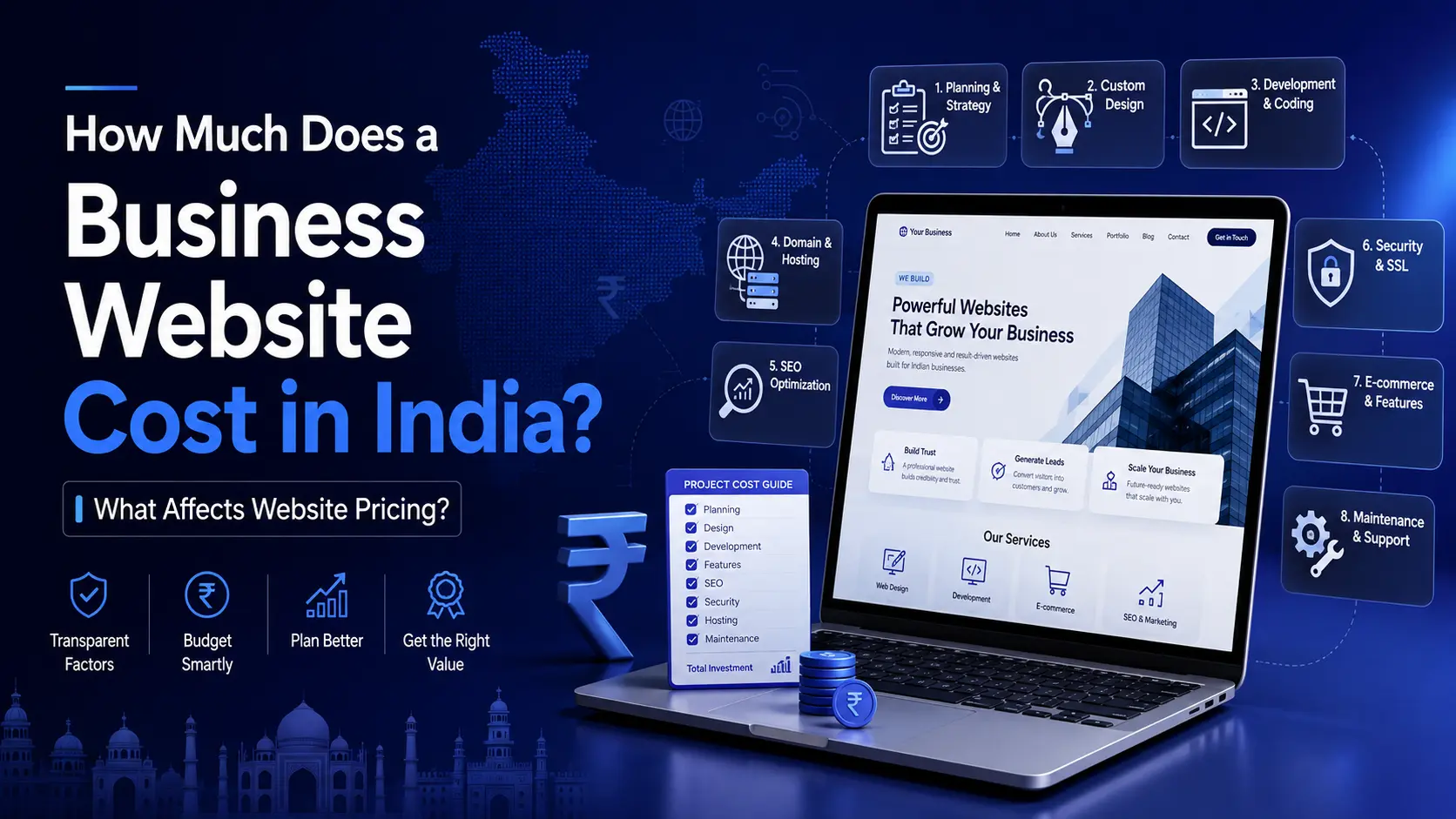
One of the first questions business owners ask when planning a new website is: How much does a business website cost in India?
There is no single price that applies to every website. A five-page informational website, an ecommerce store and a custom business application may all be called websites, but the amount of planning, design, development, testing and maintenance required for each can be very different.
The cost of a professional business website depends primarily on what the website needs to do, how much customization is required and how the project will be maintained after launch.
This guide explains typical website-development budgets in India, the major factors that affect pricing, ongoing expenses, common hidden costs and how businesses can prepare a realistic website budget.
How Much Does a Business Website Cost in India?
For budgeting purposes, business websites in India can fall into very different price ranges depending on their scope.
The following figures should be treated as illustrative budget ranges, not fixed market prices or quotations.
Website Type | Indicative Budget Range | Typical Requirement |
|---|---|---|
Basic Small Business Website | ₹15,000 – ₹35,000+ | Simple company information, services and contact functionality |
Professional Business Website | ₹35,000 – ₹80,000+ | Custom design, multiple service pages, enquiry system and SEO foundation |
Dynamic Business Website | ₹50,000 – ₹1,20,000+ | Database-driven content, administration and custom functionality |
Ecommerce Website | ₹60,000 – ₹2,50,000+ | Products, cart, checkout, payments and order management |
Custom Web Application | ₹1,20,000 – ₹5,00,000+ | Custom workflows, dashboards, users, automation and integrations |
Complex ecommerce platforms, portals, franchise systems, learning platforms or custom software can exceed these ranges significantly.
The correct price should therefore be calculated after defining the actual project scope rather than selecting a package based only on the number of pages.
Why Website Development Prices Vary So Much
Two websites may look similar from the outside while having completely different technical requirements behind them.
One may contain only static information, while another may include customer accounts, payments, databases, dashboards, automated emails, APIs and multiple administrative roles.
The following factors usually have the greatest impact on website development cost in India.
1. Type of Website
The type of website is one of the biggest pricing factors.
Common website categories include:
Small business website
Corporate website
Dynamic website
Ecommerce website
Educational or institute website
Franchise website
Learning management system
Customer portal
Custom web application
An informational business website generally requires less development than a system containing transactions, user accounts or specialized business workflows.
2. Number and Complexity of Pages
Page count affects website cost, but counting pages alone is not enough.
A simple About Us page may require significantly less work than a service page containing interactive tools, forms, custom calculations or database-driven information.
A normal business website might include:
Homepage
About Us
Service overview
Individual service pages
Portfolio or work section
Blog
Frequently asked questions
Contact page
Privacy policy
The quality and complexity of each page matter more than simply having a large number of pages.
3. Custom Website Design
Website design can range from adapting a standard layout to creating a completely custom interface around the business brand.
Custom design may involve:
Page structure planning
Responsive layouts
Custom visual sections
Brand integration
Navigation design
Conversion-focused calls to action
Mobile-specific adjustments
Accessibility considerations
A more customized website usually requires additional design and frontend-development time.
Businesses interested in the visual side of a website can also explore our website designing services.
4. Static vs Dynamic Website Development
A static website contains content directly within its pages and normally requires a developer to make structural updates.
A dynamic website stores some or all content in a database and may provide an administration panel where authorized users can manage information.
Dynamic functionality may include:
Blog management
Product management
Service management
User accounts
Enquiry records
Administrative dashboards
Search and filtering
Because dynamic websites require backend development, database design, validation and security controls, they normally cost more than simple static websites.
5. Backend and Admin Panel Requirements
An admin panel allows authorized staff to manage website information or business records.
The complexity of the administration system can strongly affect development cost.
Examples include:
Secure login
User roles and permissions
Dashboard
Content management
Customer records
Product management
Order management
Reports
Notifications
File management
A simple content-management screen is very different from a complete business operations dashboard.
6. Ecommerce Functionality
An ecommerce website normally requires considerably more functionality than an informational business website.
Common ecommerce features include:
Product catalogue
Categories
Product variations
Search and filters
Shopping cart
Checkout
Customer accounts
Payment gateway integration
Order management
Coupons
Shipping rules
Transactional notifications
The larger and more customized the ecommerce workflow becomes, the more development and testing it requires.
7. Custom Features and Business Automation
Custom features are often the biggest difference between a normal website and a web application.
Examples may include:
Online admissions
Franchise applications
Quotation generators
Appointment systems
Customer dashboards
Student portals
Document management
Subscription systems
Custom reporting
Automated workflows
Each custom feature needs requirements analysis, database planning, development, validation, security controls and testing.
8. API and Third-Party Integrations
Businesses often need their website to communicate with external platforms.
Examples include:
Payment gateways
SMS services
Email services
WhatsApp services
CRM platforms
Accounting systems
Maps
Shipping providers
External business APIs
Integration cost depends on the quality of the external API, the amount of data exchanged and the complexity of the required workflow.
Third-party service fees may also be separate from the website-development quotation.
9. Responsive Mobile Development
A professional website should work correctly on smartphones, tablets, laptops and desktop screens.
Responsive development involves more than shrinking a desktop layout.
Navigation, typography, forms, buttons, images and content structure may all need adjustments for smaller screens.
Mobile usability should be part of the original development scope rather than treated as an optional extra.
10. SEO Requirements
A website intended to attract organic search traffic should be developed with technical SEO foundations from the beginning.
These may include:
Semantic HTML
Clean URLs
SEO metadata
Canonical URLs
Internal linking
XML sitemap
Robots directives
Structured data
Mobile usability
Image optimization
Performance optimization
Technical SEO setup is different from an ongoing SEO campaign.
Businesses wanting ongoing search optimization can learn more about our SEO services.
11. Website Performance Optimization
Website speed can be affected by code quality, images, fonts, hosting, third-party scripts, database queries and many other technical factors.
Performance work may include:
Image optimization
Code optimization
Asset minification
Lazy loading
Database optimization
Caching
Reducing unnecessary scripts
Performance becomes particularly important for large websites, ecommerce stores and websites serving mobile users.
12. Website Security
Security should be included in professional development rather than added after the website goes live.
Depending on the project, security work may include:
HTTPS configuration
Input validation
CSRF protection
Authentication security
Password hashing
Access control
Secure file uploads
Database protection
Session security
Rate limiting
Backup procedures
Websites processing sensitive information generally require more security work than simple public informational sites.
13. Content Creation
Website content is sometimes included in a project and sometimes supplied by the client.
Content-related work may include:
Business copywriting
Service descriptions
SEO content
Blog articles
Images
Product descriptions
Content migration
The quotation should clearly state who is responsible for providing and preparing website content.
14. Domain Name Cost
A domain is the website address used by customers, such as yourbusiness.com.
Domain registration is normally a recurring expense rather than a one-time website-development charge.
Pricing depends on:
Domain extension
Registrar
Availability
Renewal price
Premium or previously registered domains may cost substantially more than standard registrations.
15. Website Hosting Cost
Hosting is the server infrastructure where the website and its data are stored.
Hosting costs vary according to:
Storage
Traffic
Processing resources
Database requirements
Email requirements
Backup features
Server management
A small business website generally needs fewer resources than a busy ecommerce store or complex web application.
16. Website Maintenance Cost
Launching the website is not necessarily the end of its cost.
Ongoing maintenance can include:
Software updates
Security updates
Backups
Bug fixes
Content changes
Performance checks
Compatibility updates
Feature improvements
Maintenance may be billed monthly, quarterly, annually or per requirement depending on the project and support agreement.
One-Time Website Cost vs Recurring Website Cost
Businesses should separate development costs from recurring operating expenses.
Typical One-Time Costs
Planning
UI/UX design
Frontend development
Backend development
Database development
Initial SEO configuration
Testing
Initial deployment
Typical Recurring Costs
Domain renewal
Hosting renewal
Business email
Maintenance
Third-party APIs
Payment-gateway charges
Premium software subscriptions where applicable
A professional quotation should make these categories clear so the business understands both the initial investment and future operating expenses.
How Much Should a Small Business Spend on a Website?
There is no universal amount that every small business should spend.
The budget should reflect the business objective.
A local service business that needs a professional digital presence may not require the same investment as an ecommerce company whose website directly processes sales.
For many small businesses, the priority should be a focused website containing:
Professional responsive design
Clear service information
Strong contact options
Basic enquiry functionality
SEO-ready architecture
Good performance
Security fundamentals
Additional functionality can be introduced later when there is a genuine business requirement.
Should You Choose the Cheapest Website Developer?
Price is important, but the lowest quotation is not automatically the most economical option.
A very low-cost website may exclude important requirements such as:
Custom design
Proper mobile optimization
SEO foundations
Security
Source-code handover
Database backup
Testing
Maintenance support
This does not mean that higher prices automatically guarantee better quality either.
Businesses should compare quotations based on the actual scope, deliverables, ownership, development process and post-launch responsibilities.
Questions to Ask Before Accepting a Website Quotation
Before approving a website-development proposal, ask for clarity on the following points.
What pages are included?
Is the design custom or template based?
Is mobile responsiveness included?
Which features are included?
Is an admin panel included?
Are SEO foundations included?
Who provides website content?
Is domain registration included?
Is hosting included?
Are third-party fees separate?
What support is available after launch?
Who owns the source code?
Will a database backup be provided?
What happens when additional features are requested?
Clear answers reduce misunderstandings later in the project.
Website Cost Should Be Based on Business Value, Not Only Page Count
A website should ultimately solve a business problem.
For one company, the goal may be generating enquiries. For another, it may be selling products, collecting applications, managing franchise leads or providing customers with online services.
The most useful website investment is therefore not necessarily the cheapest website or the website with the largest feature list.
It is the solution that provides the functionality the business genuinely needs while remaining reliable, secure and maintainable.
How to Reduce Website Development Costs Without Sacrificing Quality
Businesses can often control development costs by planning carefully before development begins.
Useful approaches include:
Define the primary business goal clearly
Separate essential features from future features
Prepare business content early
Provide branding assets in usable formats
Avoid unnecessary functionality
Finalize requirements before development
Use phased development for large projects
Adding features without a clear purpose increases both initial development cost and future maintenance requirements.
When Is Custom Web Development Worth the Cost?
Custom development becomes valuable when standard website solutions cannot properly support the required business workflow.
It may be appropriate when you need:
Custom user roles
Business-specific dashboards
Complex data management
Specialized automation
Custom integrations
Unique customer workflows
Long-term application expansion
For a straightforward informational website, unnecessary custom development may add cost without providing meaningful value.
Frequently Asked Questions About Website Cost in India
How much does a basic business website cost in India?
A simple small-business website may start around ₹15,000 to ₹35,000 or more depending on design quality, number of pages, content, functionality and the developer or agency handling the project.
How much does a professional website cost in India?
A professionally designed business website with custom pages, responsive development, enquiry functionality and technical SEO foundations may commonly require a higher budget, such as ₹35,000 to ₹80,000 or more.
The actual quotation should always be based on the final scope.
How much does an ecommerce website cost in India?
An ecommerce project may start around ₹60,000 and can increase substantially depending on catalogue size, checkout workflow, customer accounts, payments, shipping, integrations and administrative requirements.
Does website cost include domain and hosting?
Not always. Domain registration and hosting are often separate recurring expenses. A quotation should clearly specify whether they are included and who is responsible for renewals.
Is SEO included in website-development cost?
Professional website development should include essential technical SEO foundations. However, ongoing SEO campaigns, content strategy and competitive optimization are normally separate services.
Why do two developers quote different prices for the same website?
The quotations may differ because of design approach, functionality, development quality, testing, security, support, technology, ownership terms and what is actually included in the project.
Can I build the website in phases?
Yes. Larger projects can often be divided into phases. Businesses can launch essential functionality first and introduce lower-priority features later when the architecture has been planned for expansion.
Is website maintenance compulsory?
Maintenance requirements vary, but every website should at least have appropriate backups, security monitoring and software compatibility checks. Dynamic websites and web applications generally require more ongoing attention than simple static websites.
Final Thoughts
The answer to how much a business website costs in India depends on the business requirement rather than a single fixed rate.
A small informational website may require a relatively modest investment, while ecommerce platforms and custom applications can require substantially larger budgets because they involve more functionality, security, testing and maintenance.
Before choosing a developer, clearly define what your customers need to do on the website, which features are essential, what information you need to manage and what future expansion you expect.
A well-planned website budget should consider not only initial development but also domain, hosting, maintenance, integrations and future improvements.
If you are planning a business website and want a quotation based on your actual requirements, explore our website development services or contact SparkHub 360 to discuss your project.