
Crawlability
Important pages accessible
Technical SEO Services
Technical SEO That Helps Search Engines Crawl, Understand & Trust Your Website.
We review the technical foundation behind your website so important pages are easier to crawl, index and interpret correctly — without breaking the user experience or the application behind it.
Indexability
Correct pages indexable
Architecture
Clear page relationships
Performance
Faster page delivery
Mobile
Responsive experience
Jamshedpur-based SEO support · Technical SEO services across India

Why Technical SEO Matters
Great Content Can Still Struggle If the Technical Foundation Sends Mixed Signals.
A website may have useful content and strong service pages, but search visibility can still suffer if crawlers hit blocked routes, duplicate URLs, broken redirects, weak internal architecture, inconsistent canonicals or heavy page delivery.

Search engines need a clean path to important pages
Blocked routes, broken links, redirect loops or inconsistent navigation can make discovery harder than it should be.
The right pages should be indexable — not every URL
Thin utility URLs, duplicates or accidental noindex rules can create unnecessary indexation problems.
Important pages should not be buried deep in the site
Clear hierarchy and useful internal paths make it easier for visitors and crawlers to understand what matters.
Slow or unstable pages create avoidable friction
Heavy assets, inefficient delivery or unstable layouts can weaken both user experience and technical quality.
What We Check in Technical SEO
Core Technical Signals Reviewed as One Connected System.
Technical SEO works best when crawlability, indexation, architecture, canonicalisation, performance and mobile behaviour support the same website structure rather than contradict each other.
Crawlability & Broken Links
Review whether important pages are reachable and whether crawl paths are interrupted by broken or unnecessary URLs.
Indexability & Meta Robots
Check whether the intended pages are indexable and whether accidental noindex or conflicting directives exist.
XML Sitemap & Robots.txt
Review sitemap coverage and robots directives so they support the actual site structure and crawl strategy.
Canonical URLs
Check whether canonical references point to the preferred URL consistently and avoid obvious duplication conflicts.
Redirects & Status Codes
Review important 3xx, 4xx and 5xx behaviour so migrations, changed URLs and removed pages are handled intentionally.
Internal Architecture
Assess whether important service, category and supporting pages are sensibly connected through navigation and internal links.
Page Speed & Core Web Vitals
Review major delivery bottlenecks, layout instability and avoidable page weight where they affect user experience.
Mobile Usability
Check responsive behaviour, viewport handling and obvious mobile interaction issues on important search pages.
Crawl + Index Architecture
Search Engines Need A Clear Technical Route Through the Website.
We map how important pages are discovered, linked, canonicalised and indexed so technical signals support the business structure instead of fighting against it.
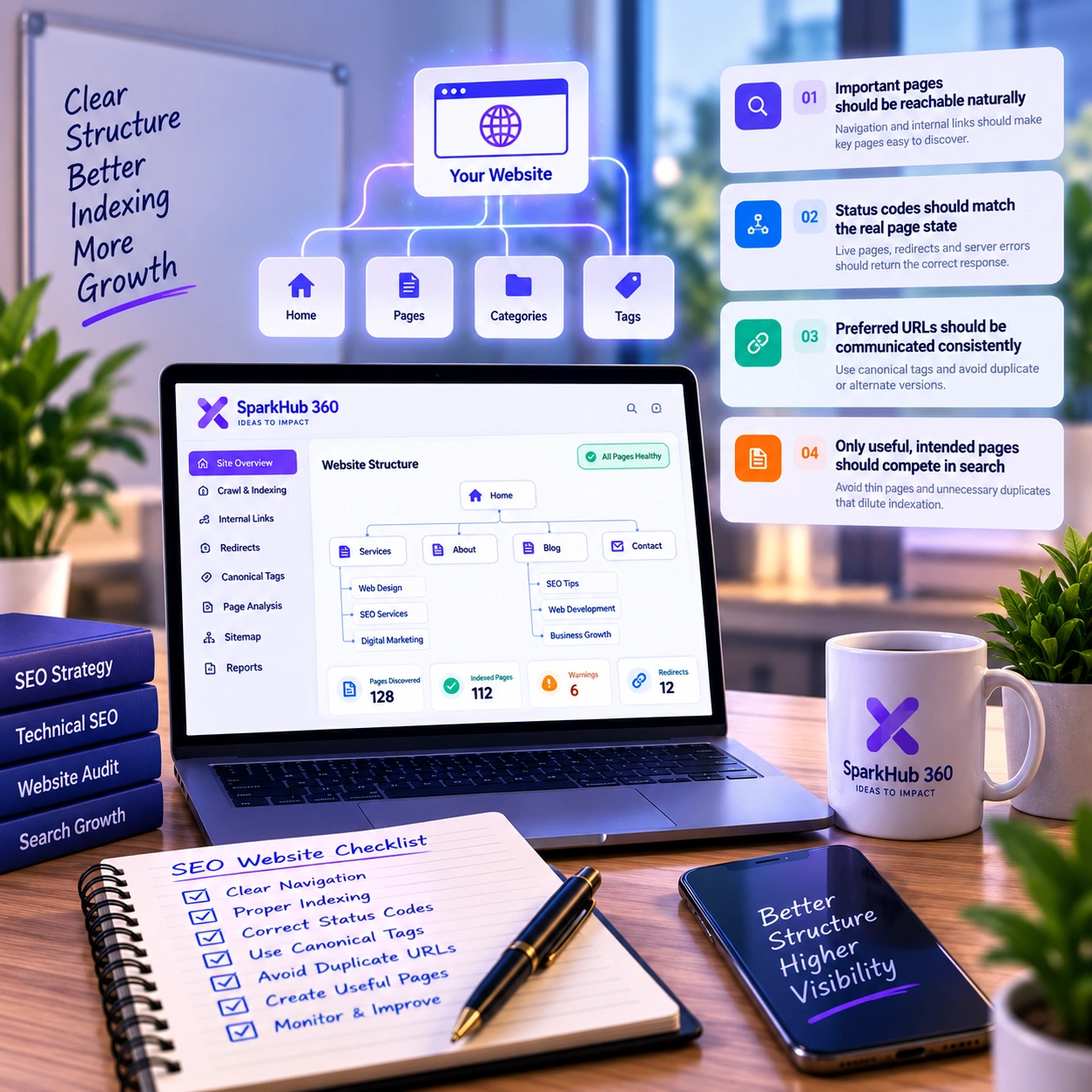
Discovery
Important pages should be reachable naturally
Navigation, internal links and sitemap coverage should make key pages easy to discover without depending on hidden or orphaned URLs.
Routing
Status codes should match the real page state
Live pages, redirects, missing pages and server errors should return the correct response instead of confusing crawlers.
Canonicalisation
Preferred URLs should be communicated consistently
Canonical signals help consolidate duplicate or alternate URL versions when the implementation actually supports them.
Indexation
Only useful, intended pages should compete in search
Indexability rules should reflect the site strategy rather than allowing every generated or duplicate URL into the index.
Our Technical SEO Process
From Technical Audit To Clear Fixes, Implementation & Validation.
We identify the root cause first, prioritise issues by impact, implement or coordinate the appropriate fix and then re-check the affected pages or technical signals after the change.
01
Audit
Review Crawl, Indexing & Technical Signals
We review important URLs, directives, page responses, sitemaps, canonicals, architecture and major performance issues.
02
Prioritisation
Separate Critical Problems From Low-Impact Noise
We focus first on issues that affect important pages, crawl paths, indexation or business-critical search visibility.
03
Implementation
Apply or Coordinate the Correct Technical Fix
Changes may involve routing, metadata, canonicals, sitemap output, templates, links, assets or server/application behaviour.
04
Quality
Review Page Delivery & Mobile Behaviour
We review important page experience issues where delivery, responsive behaviour or asset weight create avoidable technical friction.
05
Validation
Retest the Changed Signals
We verify that the affected URLs, directives, redirects or page-level technical behaviour now match the intended implementation.
Technical SEO FAQs
Questions Before Fixing the Technical Search Foundation.
Technical SEO overlaps with development, hosting and broader SEO strategy. Some fixes can be handled directly in templates or configuration, while others depend on application architecture, server access or third-party systems.
01 Basics What is technical SEO?
Practical answer
Technical SEO focuses on the website infrastructure and implementation that affect crawling, indexing, URL signals, page delivery and how search engines understand the site. It includes areas such as robots directives, sitemaps, canonicals, redirects, status codes, architecture, performance and mobile usability.
02 Crawling What is the difference between crawlability and indexability?
Practical answer
Crawlability is about whether a search engine can discover and access a URL. Indexability is about whether that page is eligible to be stored and shown in search results. A page can be crawlable but still intentionally or accidentally non-indexable.
03 Sitemaps Do you review XML sitemap and robots.txt files?
Practical answer
Yes. We review whether sitemap URLs represent the intended indexable pages and whether robots directives support the crawl strategy without accidentally blocking important content.
04 Canonical Why are canonical tags important?
Practical answer
Canonical tags help indicate the preferred version of a page when duplicate or alternate URLs exist. They should be implemented consistently and should not conflict with redirects, noindex rules or the actual site structure.
05 Redirects Can you fix redirect chains and broken URLs?
Practical answer
Yes, when the site routing and hosting setup allow it. We review whether old or changed URLs should redirect, return a proper not-found response or be restored according to the site structure.
06 Performance Is page speed part of technical SEO?
Practical answer
Yes, page delivery and user experience are relevant technical quality areas. We review major issues such as heavy assets, unstable layouts or avoidable front-end weight, while deeper infrastructure problems may require development or hosting changes.
07 Mobile Do you check mobile technical issues?
Practical answer
Yes. We review important responsive behaviour, viewport handling, page usability and obvious mobile implementation problems on key search pages.
08 Results Will fixing technical SEO guarantee higher rankings?
Practical answer
No. Technical SEO improves the foundation, but rankings also depend on content quality, search intent, competition, authority and other signals. The goal is to remove avoidable technical barriers and make the site easier to crawl and interpret correctly.