
Catalogue
Products, categories & variants
E-Commerce Development Services
E-Commerce Development Built for Products, Payments, Orders & Growth.
We build e-commerce systems for businesses that need more than attractive product pages — including structured catalogues, pricing logic, cart and checkout, payment workflows, order management, inventory visibility, admin controls and connected business services.
Cart & Checkout
Purchase flow
Orders
Status & fulfilment
Integrations
Payments & services
Admin
Operations & reporting
Jamshedpur-based team · E-commerce development services across India

More Than an Online Product Catalogue
A Working E-Commerce System Connects the Entire Buying Journey.
A reliable online store needs product data, pricing, availability, checkout, payments, order status and administration to work together. We plan these parts as one commerce workflow instead of treating them as separate pages.
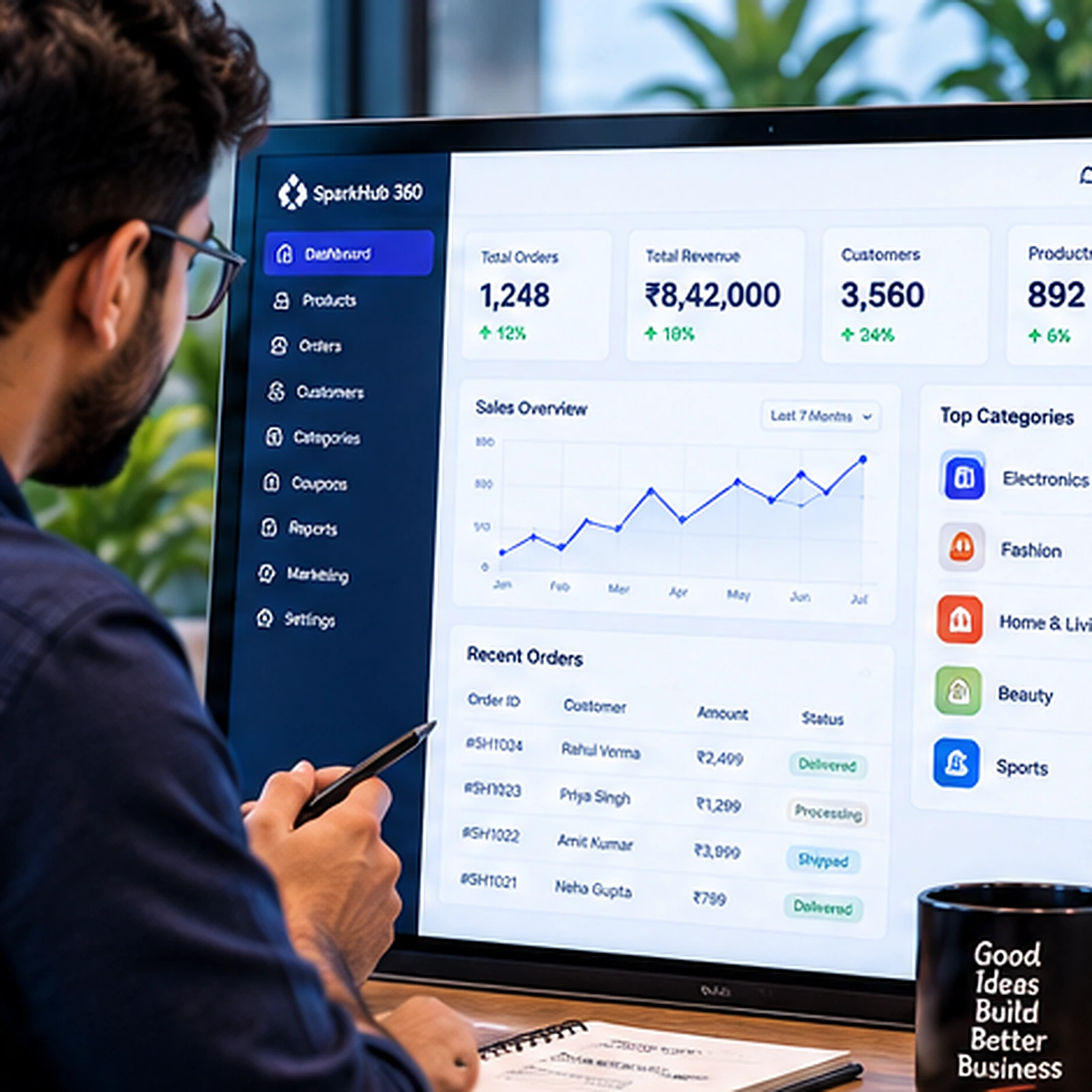
Products, categories, variants and pricing
Plan product information, categories, options, stock status and pricing rules so customers can find and understand what they are buying.
Cart and checkout that stay simple
Reduce unnecessary friction between product selection and purchase by keeping totals, customer details, delivery and payment steps clear.
Orders need a usable operational flow
Order records, customer details, payment state and fulfilment status should remain understandable for the team handling day-to-day operations.
Admin tools should support daily operations
Products, orders, customers, promotions, content and reports should be manageable from a structured backend appropriate to the project.
E-Commerce Development Capabilities
Commerce Features Built Around the Business Model.
Different stores need different capabilities. We choose modules around the products, customer journey and operational requirements instead of adding features simply to make the platform look bigger.
Products & Categories
Structured product pages, categories, attributes, options and media.
Variants & Pricing
Size, colour, pack, plan or other project-specific options and price rules.
Cart & Checkout
A clear buying flow with totals, customer details and checkout steps.
Payment Integration
Connect supported payment providers according to their API and project requirements.
Order Management
Track order records, payment state and fulfilment status in one workflow.
Shipping / Delivery Flow
Plan delivery information and supported service connections where required.
Accounts & Order History
Customer access, saved details and order visibility when useful for the business.
Admin & Reporting
Operational dashboards, filters and reports based on the project scope.
Connected Commerce
Your Store Should Work With the Services Around the Business.
Modern e-commerce often depends on payment, messaging, delivery, email, analytics or other business services. We connect supported providers when the integration creates real operational value.
Payment
Payment Gateways
Integrate supported payment services based on provider APIs, account configuration and project scope.
Communication
WhatsApp / Messaging
Use approved provider methods for order communication or customer support when required.
Delivery
Shipping & Fulfilment Services
Connect delivery or fulfilment providers when the service offers a suitable integration method.
Email
Transactional Email
Send important order or account communication through properly configured email workflows.
Business Systems
CRM / External Tools
Connect supported business services when data needs to move between systems.
Measurement
Analytics & Conversion Tracking
Add approved analytics and marketing measurement according to the project configuration.

Our E-Commerce Development Process
From Product & Order Logic To a Store Ready for Real Transactions.
We plan e-commerce around the complete selling workflow: products, customer journey, payment, order handling, administration and fulfilment. That avoids building a good-looking storefront with a weak operational backend.
01
Discovery
Understand Products & Business Model
We review product types, categories, pricing, customers, delivery, payments, current processes and operational requirements.
02
Commerce Flow
Plan Catalogue, Checkout & Order Journey
We define how products are organised, how customers buy and how the business team receives and processes each order.
03
Development
Build Storefront & Business Logic
Catalogue, cart, checkout, account flows, admin modules and project-specific commerce logic are developed in structured parts.
04
Integration
Connect Payments & Required Services
Supported payment, communication, delivery or other services are connected according to the approved project scope.
05
Test & Launch
Review the Complete Buying Workflow
We review critical customer journeys, responsive behaviour, order actions and production configuration before launch.
E-Commerce Development FAQs
Questions Before Building an E-Commerce System.
The right e-commerce scope depends on product complexity, payment flow, order handling, delivery requirements, administration and the services that need to connect with the store.
01 Project Fit What kind of e-commerce projects can SparkHub develop?
Practical answer
We can plan and develop product-based online stores and custom commerce workflows where catalogue, checkout, payments, orders, customer accounts, admin operations or integrations are required. The final scope depends on the business model.
02 Products Can the store support product categories and variants?
Practical answer
Yes. Product categories, attributes and options such as size, colour, pack or other project-specific variations can be planned according to the catalogue structure.
03 Payments Can you integrate an online payment gateway?
Practical answer
Yes when the payment provider offers a supported integration method and the merchant account is properly configured. Exact implementation depends on the provider API, compliance requirements and project scope.
04 Orders Will there be an admin area to manage orders?
Practical answer
An order-management area can be included so authorised users can view order details, payment state and fulfilment status. The exact controls depend on the approved workflow.
05 Delivery Can shipping or delivery services be integrated?
Practical answer
Yes when the selected service provider offers a suitable API or supported integration method. Requirements such as serviceability, rates, labels or tracking should be reviewed before development.
06 Mobile Will the e-commerce website work properly on mobile?
Practical answer
Yes. The storefront and checkout can be designed responsively for desktop, tablet and mobile use, with special attention to product browsing, cart actions and checkout usability.
07 Maintenance Can the store be expanded later?
Practical answer
Yes when the original architecture is planned for maintainability. New products, modules, reports or integrations can be added later based on business needs and technical compatibility.
08 Budget How much does e-commerce development cost?
Practical answer
Cost depends on catalogue size, variants, checkout requirements, payment integrations, customer accounts, order workflow, shipping, admin modules, data migration and custom business logic. We review the requirement before recommending a scope.