
CodeIgniter Development Services
CodeIgniter Development Structured PHP Without Unnecessary Complexity.
We build CodeIgniter-powered websites and custom web applications for businesses that need clean PHP architecture, database-driven workflows, secure forms, dashboards, integrations and maintainable backend logic.
Jamshedpur-based team · CodeIgniter development services across India

Why CodeIgniter 4
A Lightweight Framework For Structured PHP Development.
CodeIgniter gives PHP projects a clear application structure without forcing unnecessary complexity. It helps organise controllers, models, validation, routing, database operations and reusable business logic so the application stays easier to understand and maintain.
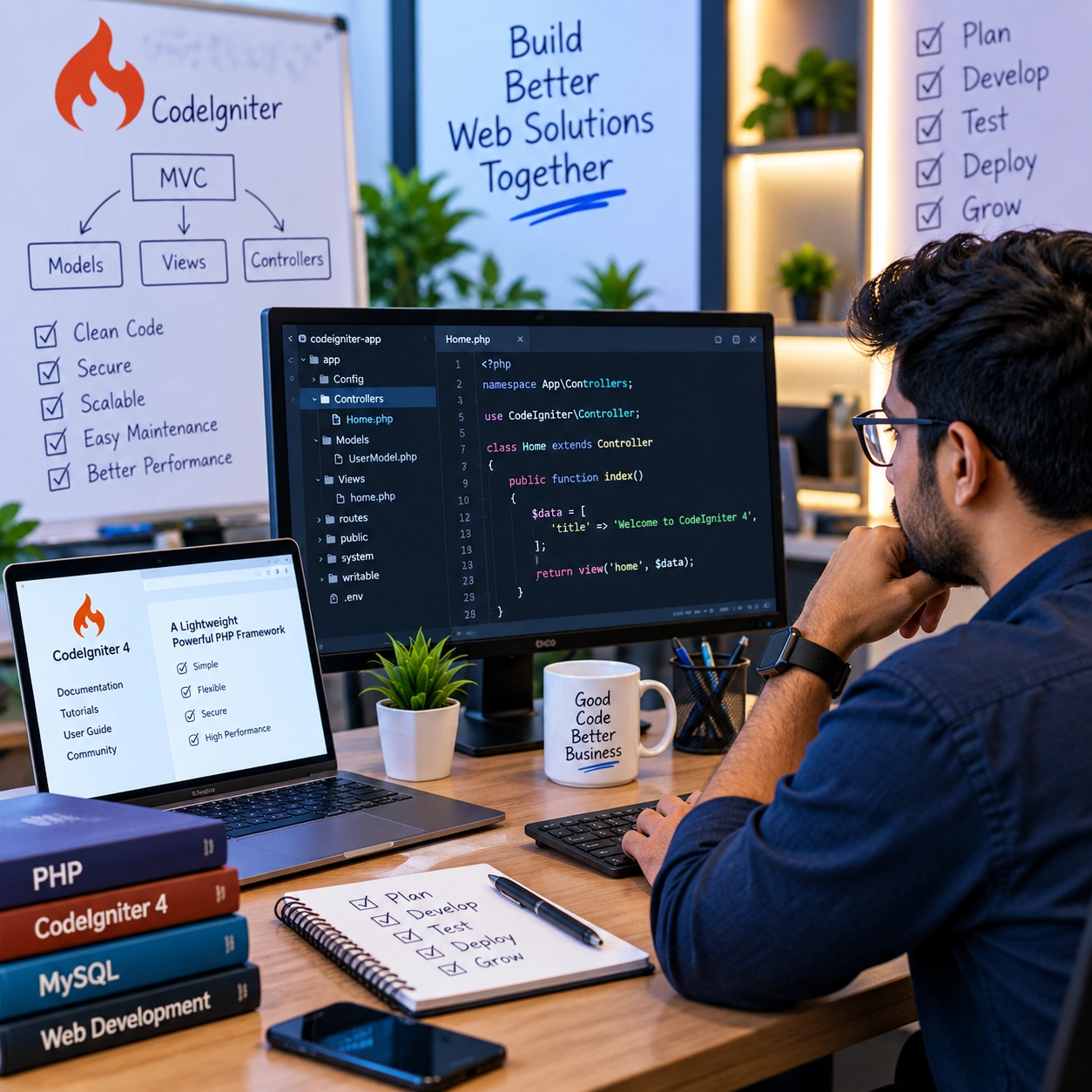
Clear separation of application responsibilities
Keep request handling, business logic, data access and presentation organised instead of mixing everything inside individual PHP pages.
Clean and controlled application URLs
Define predictable routes for public pages, forms, dashboards, APIs and application actions while keeping controller responsibilities clear.
Structured data access and workflows
Use models, Query Builder and validation around business data such as users, enquiries, orders, content, reports and internal records.
Framework-supported security foundations
Use validation, CSRF protection, sessions, filters and safer application patterns rather than rebuilding common security controls from scratch.
Lean framework for practical business builds
CodeIgniter keeps the framework footprint controlled, which is useful when a project needs straightforward server-side performance and shared-hosting compatibility.
Easier upgrades and future changes
A consistent project structure makes future features, fixes and handover easier than a codebase built from disconnected scripts.
What We Build with CodeIgniter
Business Web Solutions Built on a Clean CodeIgniter Structure.
CodeIgniter works especially well when a project needs structured PHP logic, relational data, secure forms, dashboards, user roles or connected services without the overhead of an unnecessarily complex stack.
Custom Business Web Applications
We use CodeIgniter for custom applications where the website needs to do more than display content — including business rules, user roles, database operations, internal tools and workflow-driven actions.
- Role-based access
- Database-driven workflows
- Custom forms and validation
- Business-specific logic

Admin Panels & Dashboards
Management interfaces for enquiries, users, records, content, reports and day-to-day operational workflows.
Customer / Staff Portals
Secure login-based portals for customers, partners, students, staff or internal teams with role-aware access.
Workflow-Driven Systems
Structured steps for approvals, applications, enquiries, records, status changes and other repeatable business processes.
API & Third-Party Integrations
Connect payment, messaging, email, CRM or other services when the application requires external systems.
Database-Driven Websites
Dynamic websites where content, users, enquiries, products, listings or records need controlled database management.
Why Choose CodeIgniter
A Practical Framework Choice When the Project Needs Structure Without Bloat.
Controlled framework overhead
CodeIgniter gives a clear application structure without forcing a large runtime or unnecessary layers into straightforward business projects.
Organised MVC project structure
Controllers, models, views, validation and reusable logic remain easier to locate, review and maintain than disconnected PHP scripts.
Strong fit for database-driven workflows
The framework works well for applications that depend on relational data, forms, records, dashboards, user accounts and repeatable business processes.
Practical maintenance and enhancements
Consistent routing and application structure make later fixes, new modules and feature changes easier to approach in a controlled way.
CodeIgniter is a strong option when a PHP project needs an organised architecture, reliable routing, database workflows and framework-level security while still staying lean enough for practical business deployment and maintenance.
Our CodeIgniter Development Process
From Requirement To a Structured CodeIgniter Application.
We plan the application structure before writing business logic. Routes, controllers, models, validation, database relationships and user flows are defined in stages so the project stays easier to test, maintain and extend.
Understand the Business Workflow
We review users, forms, data, dashboards, actions, permissions and integrations so the application solves the actual business requirement.
Plan Routes, Modules & Data
We define route groups, controllers, models, database relationships and module boundaries before implementation becomes expensive to change.
Build the CodeIgniter Application
Views, controllers, models, validation, forms, authentication and required integrations are developed in organised and reviewable parts.
Review Logic, Access & Validation
We test critical workflows, user permissions, forms, validation, database actions, responsive behaviour and production configuration.
Deploy, Monitor & Support
After final checks, the application is deployed to production and future fixes, modules or enhancements can continue on the same structured foundation.
CodeIgniter Development FAQs
Questions Before Starting a CodeIgniter Project.
The right CodeIgniter scope depends on what the application needs to do, how data moves through the system and how future maintenance should work. These are the practical questions businesses usually ask before development starts.
01 Framework Fit Is CodeIgniter suitable for a business website or custom application?
Yes. CodeIgniter can support business websites, portals, dashboards, internal tools and database-driven applications. It is especially useful when the project needs structured PHP logic without unnecessary framework overhead.
02 Architecture Why use CodeIgniter instead of plain PHP?
CodeIgniter provides an organised application structure for routes, controllers, models, validation, sessions and reusable logic. This usually makes a growing project easier to understand, test and maintain than a collection of disconnected PHP scripts.
03 Database Can CodeIgniter handle database-driven business workflows?
Yes. CodeIgniter works well with relational databases for users, enquiries, orders, content, records, reports and internal workflows. The database structure should be planned around the actual business process before implementation.
04 Security How do you approach security in a CodeIgniter application?
We use framework-supported validation, CSRF protection, filters, sessions, authentication controls, permission checks and safer database access patterns. The exact security controls depend on the sensitivity and workflow of the application.
05 Integrations Can CodeIgniter connect with payment, SMS, email or third-party APIs?
Yes, when the external provider offers a supported API or integration method. Payment gateways, messaging services, email systems, CRM tools and other third-party services can be connected according to the project scope.
06 Maintenance Can you maintain or upgrade an existing CodeIgniter project?
Yes, but the existing version, project structure, PHP compatibility, database design and third-party dependencies should be reviewed first. That review determines whether an upgrade, refactor or partial rebuild is the safer path.
07 Budget How much does CodeIgniter development cost?
Cost depends on the number of modules, user roles, database complexity, dashboards, integrations, migration work, admin features and testing requirements. We first review the requirement and then recommend a practical scope.