
Website Development for Small Businesses in India: Complete Guide 2026
Learn how professional website development helps Indian small businesses build trust, generate enquiries, improve visibility and grow online.
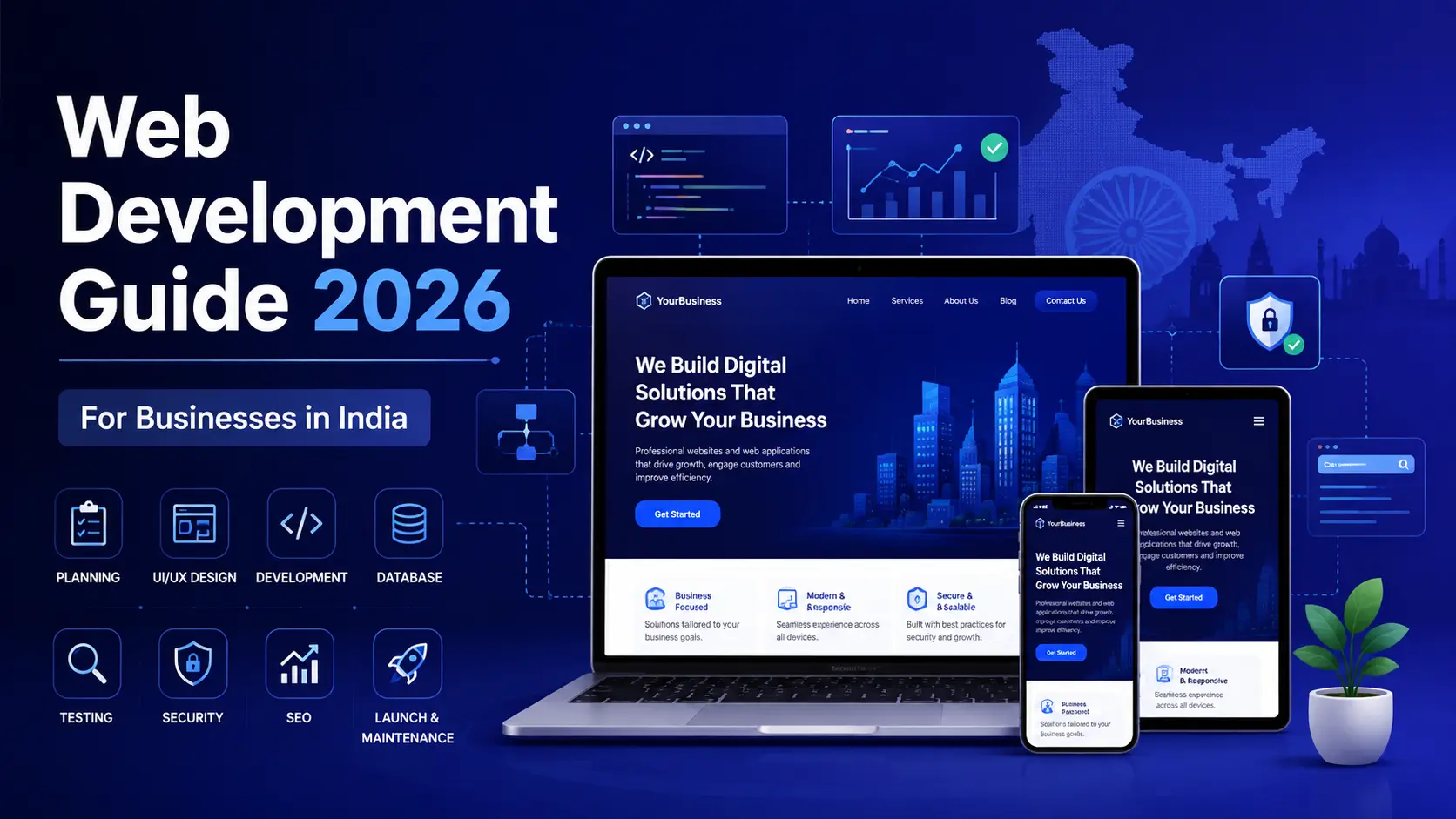
A business website is no longer simply an online brochure. For many customers, it is the first place where they discover a company, compare its services, check its credibility and decide whether to make an enquiry or purchase.
Professional web development combines design, frontend development, backend programming, databases, security, performance and search-engine readiness to create a website that actually supports business goals.
For businesses in India, the right website can help generate enquiries, sell products, provide services online, automate repetitive work and build credibility with customers across cities, states and even international markets.
This guide explains what web development for businesses in India involves, the major types of websites, the development process, important technologies, security and SEO considerations, and what businesses should evaluate before choosing a development partner.
What Is Web Development?
Web development is the process of building and maintaining websites and web-based applications that work through a browser.
While website designing primarily focuses on visual presentation and user experience, web development handles the technical functionality behind the website.
A professional development project may include:
Frontend interface development
Backend programming
Database development
Contact and enquiry forms
User registration and authentication
Admin dashboards
Online payment integration
API integrations
Search and filtering systems
SEO-friendly technical architecture
Website security
Performance optimization
Hosting and production deployment
Maintenance and future upgrades
The exact functionality depends on the purpose of the business and what users need to accomplish on the website.
Why Professional Web Development Matters for Indian Businesses
Indian customers increasingly research businesses online before contacting them. A website therefore needs to do more than simply exist.
It should communicate clearly, load quickly on mobile networks, work properly on different devices and make it easy for visitors to take the next step.
1. Builds Business Credibility
A professionally developed website provides customers with a reliable place to verify your services, contact information, business details and expertise.
Clear pages, professional presentation, secure HTTPS and consistent branding can help create confidence before a customer contacts your business.
2. Generates Enquiries and Leads
A business website can work as a continuous enquiry channel through strategically placed contact forms, quotation requests, phone actions and WhatsApp buttons.
The development should make these actions simple rather than forcing visitors through complicated forms or confusing navigation.
3. Supports Customers Beyond Your Local Area
A business may be physically located in one city while serving customers across India.
A properly structured website allows customers from different locations to discover your services, understand your process and contact you without visiting your office.
4. Automates Business Processes
Custom web development can reduce repetitive manual work.
Depending on the business, a website or web application may automate:
Customer registrations
Online applications
Quotation requests
Course enrolments
Product orders
Appointment requests
Document submissions
Payment collection
Franchise enquiries
Customer notifications
5. Creates a Platform for Long-Term Growth
A well-planned website can be extended as the business grows.
New services, integrations, locations, user roles, payment options and automation features can be introduced without rebuilding everything from the beginning when the original architecture is scalable and maintainable.
Website Designing and Web Development Are Different
Website designing and web development are closely connected, but they solve different parts of the project.
Website design deals with presentation, layout, colours, typography, visual hierarchy, responsiveness and user experience.
Web development converts that interface into a functioning system and connects it with business logic, databases, forms, authentication, integrations and server-side functionality.
For example, an ecommerce product page may look attractive because of good design, but development handles the shopping cart, customer account, database, payment processing, order validation and administrative controls behind it.
Businesses planning a new website should consider both areas together rather than treating appearance and functionality as completely separate decisions.
Common Types of Web Development for Businesses
There is no single website architecture suitable for every organisation. The correct solution depends on the business model, customer journey and required functionality.
Business Website Development
A business website presents the company, services, capabilities, contact details and important trust information.
It is suitable for consultants, service providers, agencies, manufacturers, institutes, professional firms and many small and medium businesses.
Dynamic Website Development
A dynamic website stores and manages content through a database or administrative system.
It is useful when information needs to be updated regularly, such as services, articles, products, announcements, locations or other structured content.
Ecommerce Development
An ecommerce website allows businesses to sell products or services online.
Typical functionality can include:
Product catalogue
Categories and filters
Shopping cart
Checkout
Online payments
Customer accounts
Order management
Inventory-related functionality
Coupons or promotional features
Transactional notifications
Custom Web Application Development
A custom web application is developed around a specific business workflow instead of providing only informational pages.
Examples include customer portals, internal management systems, enquiry platforms, dashboards, online application systems and specialized business tools.
LMS and Education Portal Development
Educational institutions and training businesses may require functionality such as student registration, course management, online learning materials, assessments, certificates or administrative dashboards.
The system should be planned according to actual academic and operational requirements instead of adding unnecessary features.
Franchise and Multi-Location Websites
Franchise businesses often need a structured website that presents the brand consistently while handling franchise enquiries, locations, services and business opportunities.
A scalable architecture also makes it easier to add legitimate location-specific information as the network grows.
Website Maintenance and Rework
Web development is also required after a website has been launched.
Typical ongoing work includes:
Bug fixing
Security updates
Performance improvements
New features
Design changes
Content-related technical changes
Server or PHP compatibility updates
Database work
API changes
Website migration
How the Professional Web Development Process Works
A successful development project should follow a clear process. Starting directly with coding without understanding the business requirement often leads to unnecessary revisions later.
Step 1: Requirement Analysis
The first stage is understanding what the business actually needs.
Important questions include:
Who will use the website?
What should visitors be able to do?
Which services or products need to be promoted?
What information needs to be managed by administrators?
Are customer accounts required?
Are online payments required?
Will external APIs or services be integrated?
What information needs to be stored?
What future expansion is expected?
Step 2: Website Planning
The requirement is converted into a practical website structure.
This may define pages, navigation, modules, database requirements, user roles, forms, integrations and the overall customer journey.
Step 3: UI and Responsive Design
The visual interface is planned for desktop, tablet and mobile users.
The objective is not simply to make the website attractive. Important actions should be easy to understand and important content should be easy to find.
You can learn more about the presentation side of a website through our website designing services.
Step 4: Frontend Development
Frontend development converts the approved interface into responsive browser-compatible code.
Common technologies include HTML, CSS and JavaScript.
Good frontend development should prioritize semantic structure, accessibility, responsiveness, performance and maintainability.
Step 5: Backend and Database Development
The backend handles server-side functionality such as authentication, business rules, database communication, administrative operations and integrations.
Depending on the project, technologies such as PHP, CodeIgniter and MySQL may be used to create a structured and maintainable application.
Step 6: Testing
Before launch, the website should be checked for functionality, usability and common technical problems.
Testing should include areas such as:
Forms and validation
Mobile responsiveness
Navigation
Authentication where applicable
Payment flows where applicable
Browser compatibility
Broken links
Website speed
Security controls
SEO-related technical elements
Step 7: Production Deployment
After testing and approval, the website is deployed to the production server and connected with its live domain, database, SSL certificate and required services.
A production deployment should also consider backups, environment configuration, error handling and access security.
Step 8: Maintenance and Improvement
A live website still requires monitoring and maintenance.
Software versions change, businesses introduce new requirements and security risks evolve. Regular maintenance helps keep the website reliable and compatible over time.
Important Features of a Professional Business Website
The exact feature list varies by project, but several fundamentals are important for most professional websites.
Mobile-Friendly Responsive Layout
Customers may access a website through smartphones, tablets, laptops and desktops.
Responsive development ensures that navigation, content, forms and important actions remain usable across different screen sizes.
Fast Loading Performance
Large images, excessive JavaScript, poorly optimized code and inefficient server responses can slow down a website.
Performance should therefore be considered during development instead of being treated as an optional optimization after launch.
Clear Calls to Action
Visitors should easily understand what they can do next.
Depending on the website, this might include:
Call now
Send a WhatsApp message
Request a quotation
Submit an enquiry
Book a consultation
Buy a product
Register for a service
Secure Forms and Data Handling
Business websites frequently collect names, mobile numbers, email addresses and enquiry details.
Forms should use appropriate server-side validation, request protection and safe data-processing practices rather than depending entirely on browser-side validation.
Easy Administration
When a website includes frequently changing business information, authorized administrators should be able to manage relevant content or records without editing source code directly.
However, unnecessary admin functionality should be avoided because every additional feature creates maintenance and security responsibilities.
Web Development and SEO Should Be Planned Together
Search engine optimization is not only about adding keywords to website content.
The technical structure created during development can directly influence how effectively search engines discover, understand and process website pages.
An SEO-friendly website should consider:
Semantic HTML structure
Logical heading hierarchy
Clean and understandable URLs
Unique page titles and meta descriptions
Canonical URLs
Internal linking
Mobile usability
Page performance
Image optimization
XML sitemaps
Robots directives
Structured data where appropriate
Correct HTTP status handling
HTTPS
SEO should therefore be considered during architecture and development rather than added as an afterthought.
For businesses that want to improve their organic visibility, see our SEO services.
Why Website Security Must Be Part of Development
Security is important for every website, not only ecommerce websites or large applications.
A website may handle contact information, authentication credentials, customer data, business documents or payment-related workflows.
Professional development should apply controls appropriate to the application, including:
HTTPS
Server-side input validation
Output escaping
CSRF protection
Secure password hashing
Authentication and authorization controls
Safe file-upload handling
Secure session configuration
Database protection
Rate limiting where appropriate
Regular backups
Software and dependency updates
Security is an ongoing process. No professional developer should describe a website as permanently or absolutely secure.
Custom Development vs Ready-Made Website Platforms
Both custom development and ready-made platforms can be useful, depending on the business requirement.
Ready-Made Platforms May Be Suitable When:
The requirement is relatively standard
The business needs to launch quickly
Advanced custom workflows are not required
The available platform already supports the important functionality
Custom Web Development May Be Better When:
The business has unique workflows
Custom integrations are required
Multiple user roles are involved
Specialized data management is required
Existing software must be integrated
The business expects significant future customization
The correct decision should be based on business requirements, ownership, budget, maintenance and long-term scalability rather than simply choosing whichever technology is currently popular.
How Much Does Web Development Cost in India?
There is no single correct price for web development because different projects require different amounts of planning, design, functionality, testing and maintenance.
Development cost may be influenced by:
Number and complexity of pages
Custom UI requirements
Backend functionality
Database complexity
User roles and permissions
Ecommerce functionality
Payment gateway integration
External API integrations
Admin dashboard requirements
Content migration
SEO requirements
Security requirements
Testing requirements
Hosting and deployment requirements
Post-launch maintenance
Businesses should therefore request a quotation based on a documented scope rather than comparing projects only by the number of pages.
How to Choose a Web Development Company in India
Choosing a development partner should involve more than comparing the lowest quotations.
Before making a decision, consider the following factors.
Understand Their Development Process
A professional team should be able to explain how requirements, design, development, testing, deployment and post-launch work are handled.
Ask About Mobile and Performance Standards
The website should be planned for real users on different devices and network conditions, not only for a large desktop screen.
Understand What You Will Receive
Clarify domain responsibilities, hosting, source-code handover, database backup, deployment details, maintenance responsibilities and third-party costs before the project begins.
Discuss Security and Backup Practices
Ask how production access, data, backups, updates and sensitive information will be handled.
Check Whether the Solution Can Grow
A business may need additional services, integrations or workflows later. The architecture should not unnecessarily restrict reasonable future development.
Avoid Unrealistic Guarantees
Be cautious when a provider guarantees search rankings, impossible delivery timelines or results that depend on factors outside the development team's control.
Why Maintainable Code Matters
A website should not only work on launch day.
Maintainable development makes future bug fixes, upgrades and new features easier to implement safely.
Good development practices may include:
Organized project structure
Reusable components
Clear separation of responsibilities
Consistent coding standards
Secure configuration management
Database migration practices
Documented deployment procedures
Version control
Backup procedures
Businesses rarely see these details directly, but they can significantly affect long-term reliability and maintenance cost.
Web Development for Small and Growing Businesses in India
A small business does not necessarily need a complicated website.
In many cases, a fast and well-organized business website with clear services, genuine business information, useful content, enquiry functionality and strong mobile usability provides more value than a large website filled with unnecessary features.
The right approach is to build what the business genuinely needs today while keeping reasonable expansion possible for tomorrow.
This is particularly important for service businesses, educational institutes, franchise businesses, local companies, professional firms, ecommerce businesses and growing organisations that want to reach customers beyond their immediate location.
Frequently Asked Questions About Web Development
What is business web development?
Business web development is the process of building a website or web application around commercial requirements such as presenting services, generating enquiries, managing customers, accepting payments or automating business processes.
How long does it take to develop a business website?
The timeline depends on the project scope. A straightforward informational website may require considerably less time than an ecommerce platform or custom web application with authentication, integrations and complex workflows.
A realistic schedule should be decided after requirements and content responsibilities are understood.
Which technology is best for web development?
There is no single technology that is best for every project.
The appropriate stack depends on functionality, hosting environment, security requirements, expected traffic, development resources, maintainability and future plans.
Does web development include SEO?
Professional development should include essential technical SEO foundations such as semantic structure, crawlable pages, mobile usability, metadata support, clean URLs and performance considerations.
Ongoing SEO strategy, content development, link acquisition and competitive optimization are broader activities that may require a dedicated SEO service.
Can an existing website be upgraded instead of rebuilt?
Yes. If the existing architecture is maintainable, many websites can be improved through design changes, performance optimization, security updates, technical upgrades or new functionality.
A technical review is normally required before deciding whether upgrading or rebuilding is the more practical option.
Do small businesses need custom web development?
Not always. A small business should use custom development when its business requirements justify it.
The objective should be to select the simplest solution that reliably solves the required business problem and can be maintained over time.
Final Thoughts
Effective web development for businesses in India is not simply about writing code or putting a company profile online.
A successful website combines business understanding, responsive design, clean development, security, performance, SEO foundations and a clear path for visitors to become customers.
The most suitable website is not necessarily the one with the largest number of features. It is the one that solves the right business problems, remains easy to use and can continue evolving as the organisation grows.
If you are planning a new business website, ecommerce platform, education portal, franchise website or custom web application, explore our website development services or contact SparkHub 360 to discuss your requirement.