
How to Choose a Website Development Company in Jamshedpur
A practical guide for Jamshedpur businesses comparing website development partners, from strategy and SEO to performance, support and long-term ownership.
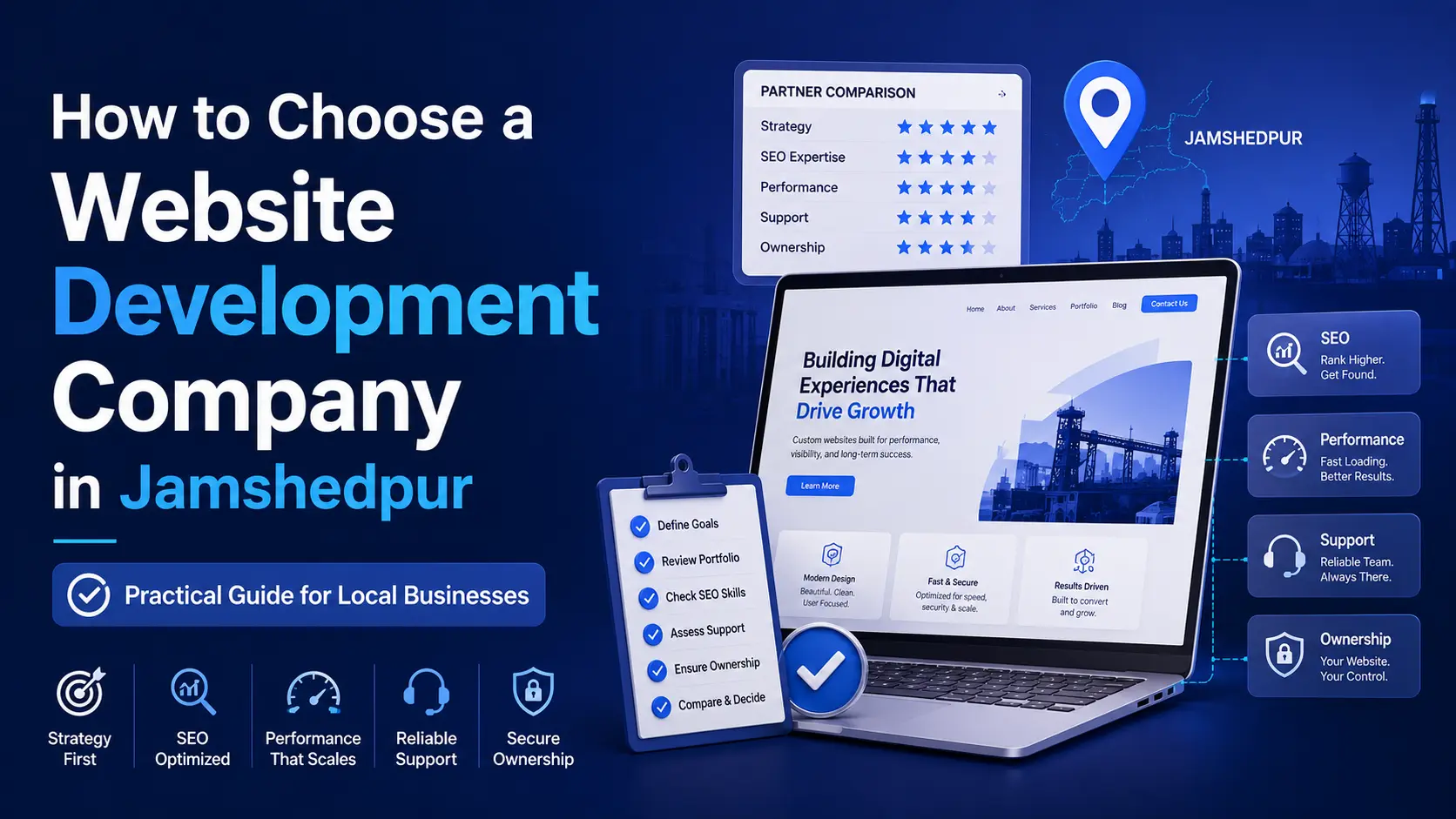
Choosing a website development company in Jamshedpur is not only a design decision. For most businesses, the website becomes a long-term sales, credibility and lead-generation asset.
That makes the selection process important. A good development partner should understand your business goal, build a fast and usable website, create a technically sound SEO foundation and give you clear ownership of the final system.
In this guide: You will learn how to compare website development companies in Jamshedpur based on strategy, SEO, performance, ownership, support and long-term value.
1. Start with the business goal, not the visual design
Before discussing colours, animations or page layouts, define what the website is expected to achieve.
Common business goals include:
Generating enquiries for a local service business
Presenting products, capabilities or industrial services
Building trust for a professional firm or consultancy
Accepting online orders through an ecommerce website
Managing courses, admissions or learning resources
Supporting franchise, dealer or branch enquiries
2. Look for a complete website strategy
Professional website design and development involves more than creating attractive pages.
Discovery and information architecture
The developer should understand what your business offers, who your ideal customer is and what information that customer needs before taking action.
Responsive mobile experience
A large share of local business traffic arrives from smartphones. Mobile usability should therefore be treated as a primary requirement.
Performance and technical quality
Images should be optimized, unnecessary scripts should be avoided and the frontend should be designed to load efficiently on real mobile networks.
3. Make sure SEO is part of the build
A sound SEO foundation normally includes:
Descriptive and stable page URLs
One clear H1 for the main page topic
Logical H2 and H3 subheadings
Unique page titles and meta descriptions
Descriptive image alt text
Internal links between related services
XML sitemap and crawl controls
Canonical URL handling
Structured data where appropriate
Fast, mobile-friendly templates
SEO reality: No developer can guarantee a number-one Google ranking. Search performance depends on competition, authority, content quality, local relevance, technical health and ongoing optimization.
4. Ask how local SEO will be handled
For a business serving Jamshedpur and Jharkhand, local relevance should be clear but natural. Repeating a city name in every paragraph is not a local SEO strategy.
5. Evaluate the portfolio for business relevance
Look at:
Clarity of navigation
Mobile responsiveness
Quality of forms and calls to action
Readability of service information
Page-loading behaviour
Consistency across the website
6. Ask the right questions before hiring
What platform or framework will be used?
Will the website be responsive?
What technical and on-page SEO work is included?
Who will own the domain, hosting and source code?
Will administrator credentials be handed over?
How are backups and security handled?
What happens when the project scope changes?
What testing is completed before launch?
Will analytics and conversion tracking be configured?
What post-launch support is included?
7. Confirm ownership before the project starts
Ownership checklist
Domain registrar access
Hosting ownership or hosting terms
Administrator credentials
Source-code access where applicable
Premium software licence conditions
Analytics and Search Console ownership
Backup access
Future maintenance charges
8. Compare quotations by scope, not only by price
Website prices vary because scope varies. A five-page lead-generation site, ecommerce store, learning portal and custom business system are fundamentally different projects.
Important: The cheapest quotation is not automatically the lowest-cost option. Rebuilding a poorly planned website later can cost considerably more.
9. Watch for common warning signs
Be cautious when a provider:
Promises guaranteed Google rankings
Cannot explain ownership of domain or source code
Does not define project scope
Uses copied website content
Ignores mobile testing
Cannot explain backup and security responsibilities
Quotes an unusually low price without defining inclusions
10. Understand what a good development workflow looks like
Discovery: Goals, audience, requirements and competitors.
Sitemap: Pages, navigation and content hierarchy.
UI direction: Visual system and key page layouts.
Development: Responsive frontend and backend functionality.
Content integration: Content, images and calls to action.
Quality assurance: Forms, links, mobile and browser testing.
SEO preparation: Metadata, sitemap and indexing controls.
Deployment: Production configuration and final checks.
Handover: Credentials, guidance and maintenance terms.
Future digital marketing requirements should also be considered during development.
11. Final website development checklist
Business objective understood
Sitemap clearly defined
Responsive design included
Performance considered
Security considered
SEO foundation included
Features clearly documented
Ownership clearly documented
Support period defined
Maintenance terms understood
Choosing the right website partner in Jamshedpur
The right development company should connect design decisions with business outcomes. A useful website should communicate clearly, load efficiently, work across devices and provide search engines with a strong technical foundation.
Planning a new website?
Prepare your business goals, required features and priority customer actions before requesting a quotation.